Plasma One is a crypto card that lets you spend stablecoins such as USDT at Visa merchants. Eligible card purchases earn cashback in XPL, the native token of the Plasma network.
Affiliate disclosure: This article contains my personal invite link. If you register through it and make eligible card purchases, I may receive referral rewards for a limited period. This does not affect the conditions you receive. The article is based on official information and my own experience using the card.
Japanese version: Read this Plasma One review in Japanese
I have been using the Plasma One virtual card in Malaysia and have received real XPL cashback payments. I currently use the Core tier, which offers up to 3% on regular purchases and up to 5% on eligible AI subscriptions.
The free Lite tier pays 2% on the first $500 of monthly spending and gives you a virtual card that can be added to Apple Pay or Google Pay. In a real MYR 20 Starbucks purchase on Core, I received $0.15 in cashback on a $4.97 charge. That is approximately 3.0%, matching Core’s published rate. However, on non-USD purchases, the free tier’s 2% reward can be almost entirely offset by roughly 2% in estimated FX-related costs. Malaysian ringgit is the real-world example in this review. Compared with Lite, Core’s $199 annual fee breaks even at about $900 in monthly regular spending. Rewards are paid in XPL, which can move in price, so Plasma One is better viewed as a card for people who already use stablecoins rather than a guaranteed high-return card.
This article reflects official information and my app activity as of August 2, 2026. Reward rates, fees, country availability and invite terms may change. Check the app and official website before applying or making a transaction.
Before applying, check the country availability section and confirm your eligibility in the app.
What is Plasma One?
Plasma One combines stablecoin storage, transfers and card spending in one app. You can fund the card balance and pay online or in person wherever the virtual Visa card is accepted.
- A virtual Visa card for online and in-store purchases
- Up to 4% base cashback on eligible purchases with Platinum
- Up to 10% on eligible AI services with Platinum
- Weekly cashback payments in XPL
- Funding with USDT, USDC and USDG across multiple networks
- Apple Pay and Google Pay support, subject to regional availability
- In-app card freezing and spending-limit controls
The service involves several providers. Plasma operates the app and rewards program, Privy supplies the wallet key-management infrastructure, Bridge supports global account and fiat on-ramp or off-ramp functions, and Rain, a Visa Principal Member, supplies the card-issuing infrastructure.
The wallet is non-custodial, but the card still depends on third parties
According to the official terms, the onchain Plasma One wallet is non-custodial. It uses Privy’s TEE-based key infrastructure, and Plasma cannot unilaterally use your private key to move funds. A recovery-key export option is also available.
That does not make every part of the service decentralized. Card issuance, identity verification and fiat transfers depend on Rain, Bridge, verification providers and other third parties. Control of the onchain wallet is therefore separate from access to the card and banking-related features. Plasma is not a bank, and stablecoin balances are not bank deposits or covered by deposit insurance.
My real Plasma One XPL cashback results
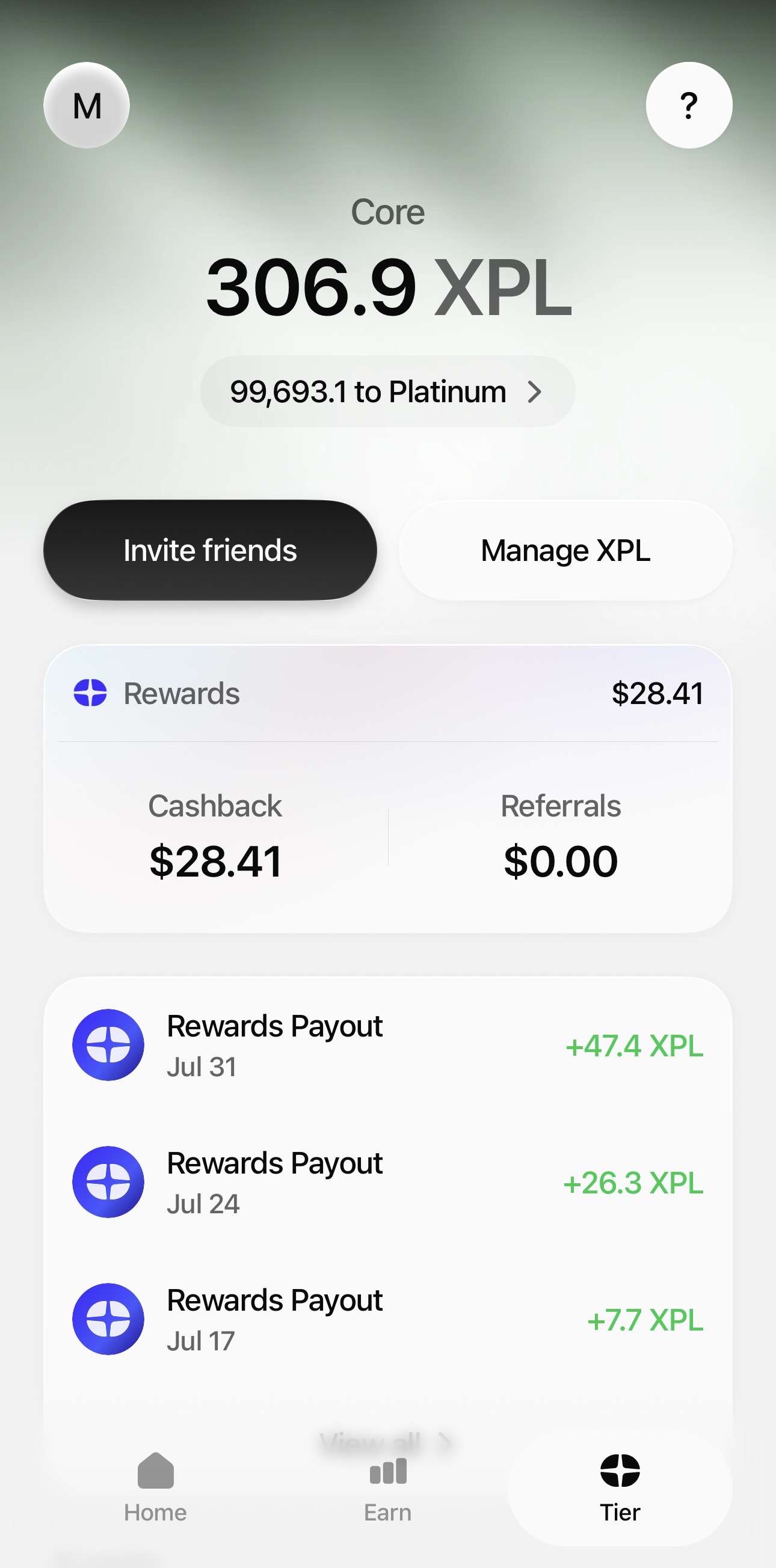
My Core dashboard shows $28.41 under Rewards, consisting of $28.41 in Cashback and $0 in Referrals. This confirms that the displayed amount came from card spending rather than referrals. The screen alone does not establish whether $28.41 is a cumulative value at payout or the current value of the XPL balance, so I treat it only as the amount shown in the app.
Rewards do not arrive in the XPL balance immediately after a purchase. They remain pending and are paid weekly. The official help page currently says payouts take place on Thursdays, but all four entries in my Malaysian app are dated on Fridays. This may be caused by time-zone or processing-time differences. Because the official page does not state a base time zone, I would not assume that rewards will always appear on the same local day or at the same time.
| Date shown in my Malaysian app | XPL received |
|---|---|
| July 10, 2026 | 16.2 XPL |
| July 17, 2026 | 7.7 XPL |
| July 24, 2026 | 26.3 XPL |
| July 31, 2026 | 47.4 XPL |
| Total across the four visible payouts | 97.6 XPL |
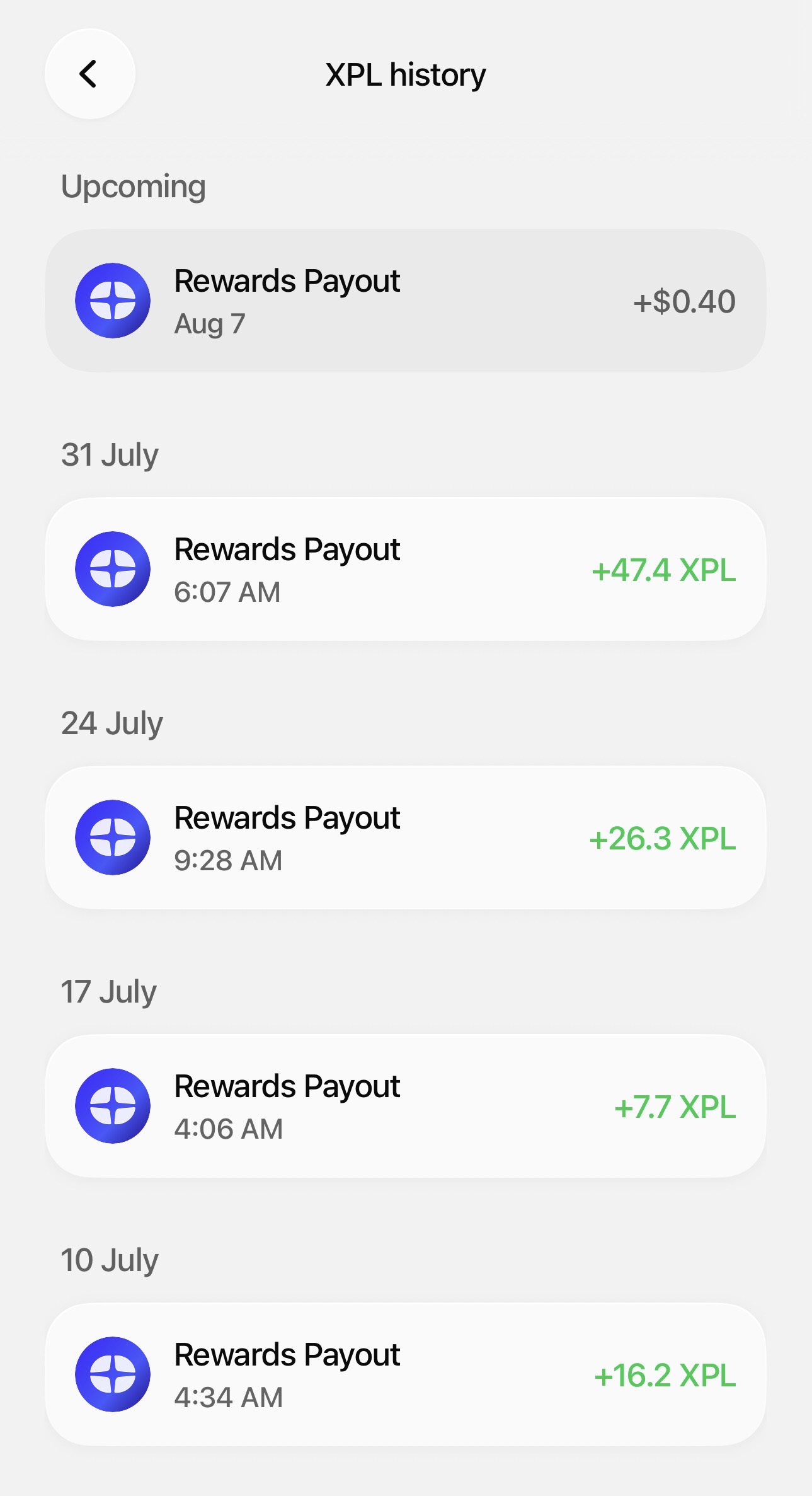
Under the official rules, cashback first accrues in US dollars and is converted into XPL at the XPL price used for each payout. The number of XPL received can therefore vary from week to week. This is why the $28.41 displayed on the dashboard and the 97.6 XPL across these four visible payouts cannot be reconciled using one current XPL price.
My screen also shows a total XPL balance of 306.9 XPL. I cannot establish that this entire balance came from the four cashback entries shown here, so I use only the directly verifiable 97.6 XPL as my documented payout result.
What can you do with the XPL?
The “Manage XPL” section lets you hold or transfer XPL, or convert it into US dollars and return the proceeds to your card balance. The conversion is an onchain trade routed through the 0x DEX aggregator, so the amount received may be affected by liquidity, spreads, slippage and network fees. If you want to lock in the value of the cashback, you also need to decide when to convert the XPL.
Lite vs Core vs Platinum
Plasma One has three tiers: Lite, Core and Platinum. They differ in access requirements, reward rates, AI rewards, FX markup, referral rewards and the number of virtual cards available.
| Feature | Lite | Core | Platinum |
|---|---|---|---|
| Access requirement | Free | $199 per year, or lock 20,000 XPL for 12 months | Lock 100,000 XPL for 12 months |
| Base rewards | 2% on the first $500 per month 0.1% thereafter |
3% on the first $1,000 per month 2% on the next $1,000 1% on the next $1,000 0.25% thereafter |
4% on the first $3,000 per month 3% on the next $7,000 2% on the next $5,000 1% thereafter |
| Eligible AI spending | Not included | 5% on the first $250 per month 4% on the next $250 1% thereafter |
10% on the first $500 per month 5% on the next $500 1% thereafter |
| Eligible airline spending | None | None | 10% with eligible airlines Reward cap: $300 per six months, up to $600 per year |
| Referral rewards | 0.25% for 3 months | 1% for 3 months | 1% for 6 months |
| Plasma FX markup | 1% | 0.5% | 0% |
| Free virtual cards | 1 | Up to 2 | Up to 3 |
AI and airline category rates replace the base rate for eligible transactions; they are not added on top of it. Monthly reward limits reset on the first day of each month. Eligible merchants, rates and conditions may change.
Lite is the easiest way to test the service
Lite has no annual fee and does not require an XPL lock. It pays 2% on the first $500 of monthly spending, making it a low-commitment way to test funding, Apple Pay and everyday card use.
For non-USD purchases, however, Lite’s effective reward can be close to zero. Based on the official guidance, the 2% reward may be roughly offset by about 2% in estimated FX-related costs. MYR spending in Malaysia is my real-world example, but the same issue can apply to other currencies. The exact result depends on the exchange rate and the value of XPL after payout. A rational way to test Lite is with USD-denominated online payments that do not require currency conversion; if non-USD spending becomes a regular use case, Core may make more sense.
Core is the practical tier for regular spending
Core pays 3% on the first $1,000 in monthly spending and up to 5% on eligible AI services such as ChatGPT, Claude and Cursor. It costs $199 per year or requires 20,000 XPL to be locked for 12 months. Core also includes a rebate of up to $8 per month for ChatGPT Go; this is not a full rebate for ChatGPT Plus.
How much do you need to spend for Core to break even?
The useful comparison is the incremental value of Core over free Lite. On the first $500 of monthly regular spending, Core pays 3% and Lite pays 2%, a difference of one percentage point. Above $500, Core remains at 3% up to $1,000 while Lite falls to 0.1%, creating a 2.9-point difference.
- Recover the $199 annual fee through regular reward differences alone: about $900 per month
- If all spending is non-USD and Core’s Plasma FX markup is 0.5 percentage points lower: about $770 per month
- If you subscribe to ChatGPT Go and use the full $8 monthly rebate: about $625 per month from regular reward differences, or about $530 when the FX-markup difference is included
These estimates compare Core with Lite, assume similar spending each month and keep the entire amount within Core’s first $1,000 reward band. They do not eliminate XPL price risk, excluded transactions, exchange-rate variation or changes to the program. A rebate only has full value if it pays for a service you would otherwise buy.
Platinum is mainly for long-term XPL holders
Platinum requires 100,000 XPL to be locked for 12 months. It pays 4% on the first $3,000 in monthly spending, up to 10% on eligible AI services, and 10% on eligible airline purchases with a reward cap equivalent to $600 per year. ChatGPT Plus and Claude Pro rebates and Visa Infinite-related benefits are also included.
XPL locked for Core or Platinum generally cannot be partially or fully unlocked during the 12-month period. Its market price can still fall, and the lock itself does not pay interest or additional XPL. Avoid buying and locking a large amount solely for card benefits unless the price and liquidity risk are acceptable to you.
The opportunity cost of locking 20,000 XPL
Core lets you lock 20,000 XPL instead of paying $199 for one year. One way to compare the avoided fee with the market value of the locked tokens is:
Annual-fee avoidance rate = $199 / (20,000 x XPL price) x 100
This is not interest or a guaranteed yield. It simply measures the fee you avoid relative to the value of the XPL you cannot move for a year. The lock may be reasonable for someone who already intends to hold XPL for more than a year. If you are buying 20,000 XPL only to access Core, a fall in price or loss of liquidity could easily outweigh the $199 saved.
Platinum has no cash-payment alternative and requires 100,000 XPL to be locked. You therefore cannot compare it with an annual fee using the same formula. Instead, compare the rewards, AI rebates and travel benefits you realistically expect to use against the opportunity cost of locking 100,000 XPL for a year.
FX costs on non-USD spending (my experience in Malaysia)
Plasma One balances are denominated in US dollars, so any purchase in another currency requires conversion. MYR is the currency in my Malaysian transactions, but the same fee structure can apply to EUR, GBP, AUD and other non-USD currencies. Plasma’s FX markup is 1% for Lite, 0.5% for Core and 0% for Platinum. The official help page separately states that a third-party Visa network cost of around 1% may apply. For Core, Plasma gives 1.5% as the example total fee input when using Visa’s exchange-rate calculator.
- Lite: roughly 2% including the estimated Visa-side cost
- Core: roughly 1.5% including the estimated Visa-side cost
- Platinum: roughly 1% including the estimated Visa-side cost
For example, Core pays 3% on regular purchases within the first $1,000 of monthly spending. If a non-USD purchase incurs around 1.5% in conversion costs, as in the official example, the remaining benefit is roughly 1.5%. That is also the framework I use for MYR purchases in Malaysia. The Visa card terms describe a non-USD transaction fee of up to 1%, and the actual result can vary with the exchange rate at settlement, the applied fees, the XPL conversion price and any later change in XPL’s market value.
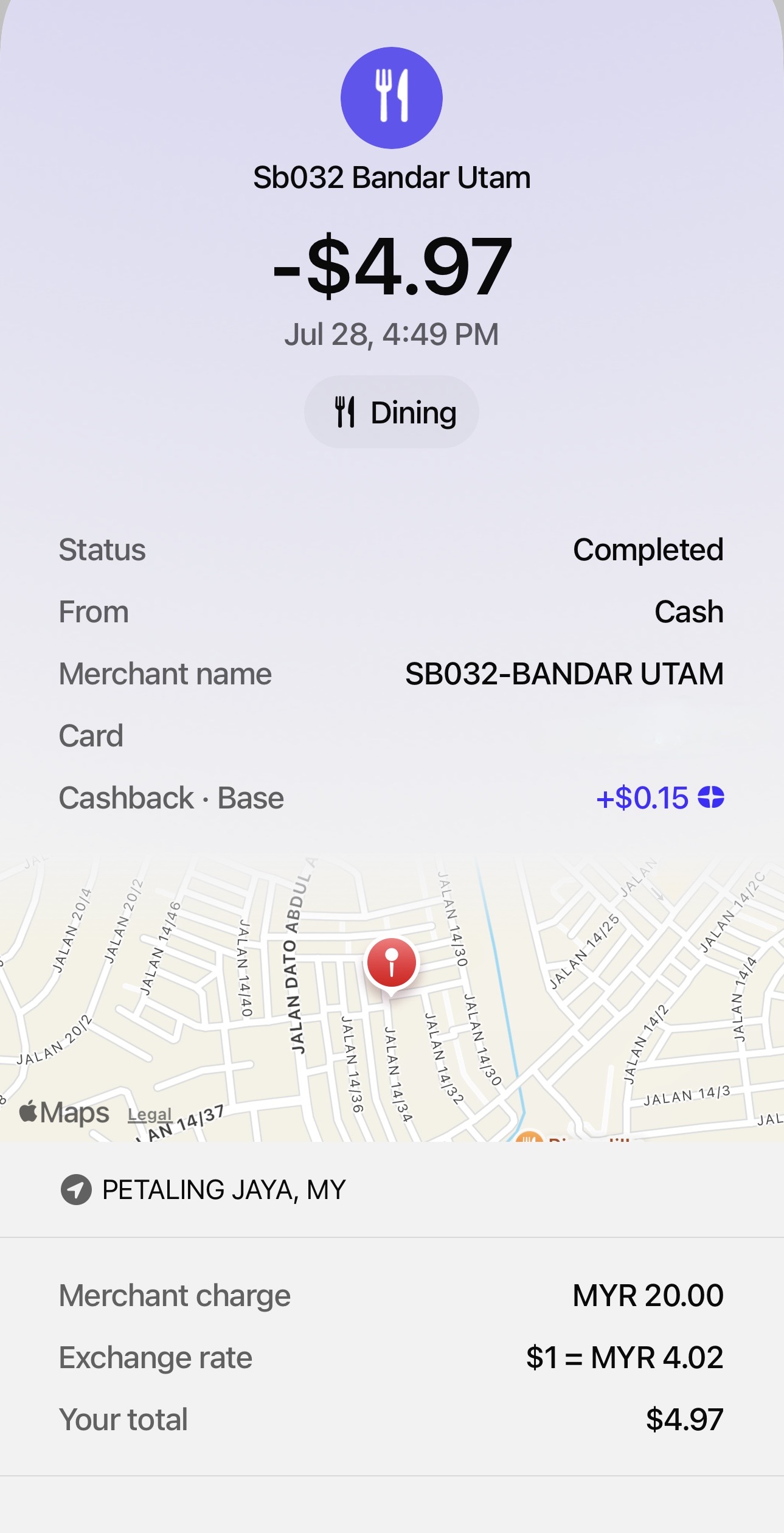
In one real transaction at Starbucks in Malaysia, I paid MYR 20 and was charged $4.97. Core credited $0.15 in base cashback. Dividing $0.15 by $4.97 gives approximately 3.0%, matching Core’s published base reward rate. The app displayed an exchange rate of $1 = MYR 4.02. This screen verifies the completed purchase and 3% reward, but it does not isolate the FX-related cost embedded in the conversion rate.
If a payment terminal asks you to choose between the merchant’s local currency and USD, choose the local currency. That means MYR in Malaysia. Choosing USD can trigger Dynamic Currency Conversion by the merchant, often at a worse exchange rate.
How to fund Plasma One
You can fund Plasma One with USDT, USDC, USDG or a supported fiat account. As of August 2, 2026, the main supported networks are:
- USDT: Plasma, Ethereum, Solana, Tron, Polygon, Arbitrum, Optimism, BNB Smart Chain and HyperEVM
- USDC: Ethereum, Solana, Base, Optimism, Polygon, Arbitrum and HyperEVM
- USDG: Robinhood Chain
The official help page states that USDT and USDG deposits are free, while USDC deposits are free up to $30,000 per transaction. The exchange or wallet you send from may still charge a network or withdrawal fee. Always confirm that both the token and network shown in Plasma One match the settings at the sending platform.
Apple Pay, Google Pay, physical cards and ATMs
The virtual card can be added to Apple Pay and Google Pay, subject to country and platform availability. I mainly use the virtual card.
Physical cards are planned for Core and Platinum but are still shown as coming soon in the official help center. ATM withdrawals are expected to become available after physical cards launch and cannot currently be used. Do not treat Plasma One as a card that can already withdraw cash from an ATM.
What works well
- The free Lite tier pays 2% on the first $500 of monthly spending
- Cashback is demonstrably paid in XPL each week
- Apple Pay and Google Pay support
- USDT funding across several networks
- Higher AI-service rewards on Core and Platinum
- A clean app interface with an easy-to-read reward history
What to watch out for
- Cashback is paid in XPL rather than US dollars or USDT
- The value of rewards can fall if XPL declines after payout
- Foreign-currency purchases may incur both Plasma and Visa-related FX costs
- Core costs $199 per year or requires a 12-month lock of 20,000 XPL
- Physical cards and ATM withdrawals are not yet available
- Stablecoin balances are not bank deposits and are not covered by deposit insurance
- Availability, fees and reward conditions can change
Country availability
Plasma One publishes lists of unsupported countries and restricted identity-document jurisdictions. Eligibility can still depend on residence, nationality, identity documents, proof of address and the card issuer’s verification process.
I completed verification as a resident of Malaysia and have successfully used the virtual card. As of August 2, 2026, neither Malaysia nor Japan appears on the published restriction lists, but that does not guarantee approval for every applicant in either country. An invite code is not an approval: applicants still need to complete KYC in the app, and availability can change.
Tax considerations
Tax treatment varies by jurisdiction. Depending on local rules, XPL cashback may be treated as a rebate, income when received, or may create a taxable gain or loss when later converted or sold. In Japan, for example, the National Tax Agency has not published Plasma One-specific guidance, and the classification can depend on the nature and regularity of the reward. Wherever you live, keep records of payout dates, XPL quantities, market value at receipt and later disposals, and seek local tax advice when needed. This article is not tax advice.
How to get started
- Obtain an invite link or access code
- Download Plasma One from the App Store or Google Play
- Create an account
- Complete identity verification
- Issue the virtual card
- Add USDT or another supported asset
- Add the card to Apple Pay or Google Pay if supported in your region
Plasma One is currently invite-only. I was given six invitation codes and publish them one at a time in this article.
The invite URL can be reused, but each access code is valid for one use only. The code below is available to the first person who successfully uses it. If it is rejected, someone may already have claimed it.
Try Plasma One
Invite code: KZBYPD
Open the invite link – first come, first servedThe invite URL is shared across all codes. Code KZBYPD is valid for one person and one use only. If you register and make eligible card purchases, I may receive a 1% referral reward on those purchases for three months.
Final verdict
Plasma One connects stablecoins with everyday Visa spending and pays weekly rewards in XPL. In my own account, I verified four consecutive XPL payouts between July 10 and July 31.
Lite is a simple way to test USD-denominated spending, but its 2% reward on non-USD purchases can be almost entirely offset by roughly 2% in estimated FX-related costs. MYR is the real-world example in this review, but the same calculation matters in any other currency. For regular spending, about $900 per month is one practical break-even point for Core’s annual fee. Before choosing a tier, consider the currency you will spend, your realistic monthly volume and whether you plan to convert XPL immediately or hold it.
Official sources and further reading
- Plasma One official page
- Plasma One Core
- Plasma One Platinum
- Plasma Terms of Service
- Cashback rates and spending bands
- Plasma One fees
- FX fees, markups and exchange rates
- Monthly rewards-limit reset
- Country and US state availability
- How to add money to Plasma One
- Plasma One Rewards Addendum
- Japan National Tax Agency: tax treatment of NFT and FT transactions (Japanese language)
- Japan National Tax Agency: tax treatment of crypto assets (Japanese language)
Disclaimer: This article is for informational purposes only and is not financial, investment or tax advice. Crypto assets and stablecoins involve price, smart-contract, liquidity, counterparty and regulatory risks. Use the service only after conducting your own research and assessing the risks.


 The Matsubara Report